Showing posts with label stem cell reviews. Show all posts

Wednesday, November 21, 2018

√ A Hairy Question: Stem Cells To Cure Baldness 2017?

I get asked all kinds of questions as a blogging professor including about the use of stem √ A hairy question: stem cells to cure baldness 2017?Stem cells to cure baldness?


I get asked all kinds of questions as a blogging professor including about the use of stem cells for cloning of humans, secual enhancement of some kind (see posts here and here) and even that question above about stem cells to cure baldness.


Many want to know if a real baldness treatment is coming based on stem cells. Every few years I do an update on that topic and that’s the focus of today’s post. You can see my past posts on this topic here and here. How much is hype versus hope versus something in the middle?


The drug finasteride really does regrow hair for some people by changing androgen signaling and inhibiting production of dihydrotestosterone, and this may affect stem cells in the hair follicle. But what about new options involving stem cells?


Conceptually, several things makes the idea of using stem cells to treat baldness very attractive. Individual hairs grow and regrow directly via stem cells in the follicle, and a lot is known about those particular dermal stem cells. This means that in theory we could grow a lot of new hair in bald people if we were confident about tackling hurdles: we could reproducibly produce enough of those “hair stem cells” for lack of a better term to address large areas of baldness, we had a good way to transplant the cells in the right place in the dermis, we had evidence that they’ll just make hair and associated structures (and not say a non-malignant, but harmful tumor of skin scar tissue), and finally that they’d stick around for many years.


I get asked all kinds of questions as a blogging professor including about the use of stem √ A hairy question: stem cells to cure baldness 2017?
Toyoshima, et al. Nature Comm.

Evidence is accumulating that achieving these four goals may be possible in the coming decade so I think right now there’s a mixture of both real hope and hype out there on this front. As to real hope, for instance, scientists have grown human hair in bald areas on rodents (see image at left). You can see that paper here, which was a big step forward in 2012 and another similar paper just came out this year.


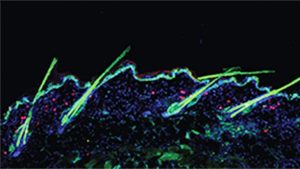
In addition to the possible approach of using hair stem cells discussed above, the other idea of using specific drugs to stimulate hair growth via existing stem cells already in our bodies is very cool and promising as well. There is a ton of research in this area and a recent paper from UCSF on connecting hair and baldness with T cells caught my eye (see image below).

I get asked all kinds of questions as a blogging professor including about the use of stem √ A hairy question: stem cells to cure baldness 2017?
Mouse hair follicles and regulatory T cells, which are shown as red dots. Image from UCSF

But there are many supposed baldness cures out there including via stem cells, mostly related to extracts of various kinds including of plant stem cells, that in my opinion seem less likely to do any good and often are very expensive. Do any of those treatments, creams, etc. including some from big name companies work? I don’t know. Has anyone tried those? There are quite a few products available on Amazon for a search for one of the ingredients often mentioned to affect hair with some role for stem cells called Stemoxydine. I’m skeptical. There are no search results on Pubmed for this compound.


Surprisingly given how many millions of people deal with hair loss including both men and women, and because of medical conditions (not just those of us losing hair not liking how it looks) there are relatively few clinical trials for searches on clincialtrials.gov for “stem cells” and “baldness.” Back in 2014 I had found 6 trials, while now today in 2017 there are only 10, and mostly they either aren’t active or aren’t directly related to “stem cells for baldness” as we think of it.


To go from hope to really helping bald people, you need clinical trials so that’s something to closely look at in coming years.


Sumber aciknadzirah.blogspot.com

Tuesday, October 9, 2018

√ Reading List Of Recent Stem Cell Pubs Headlines

2018 has started quickly on the stem cell and regenerative medicine research front with many interesting new papers and a lot of headlines. You can see my predictions for this year here.


 has started quickly on the stem cell and regenerative medicine research front with many i √ Reading list of recent stem cell pubs  headlines
Gupta, et al. Stem Cell Reports 2018 Figure 6

Below is a list of some of the more notable papers and striking news headlines. Note that just because I listed a news headline doesn’t mean a fan and in some cases below I include some words of commentary. I’ve also thrown in a few more rando papers of interest to me.


Recent interesting papers


Transient and Permanent Reconfiguration of Chromatin and Transcription Factor Occupancy Drive Reprogramming


Deriving Dorsal Spinal Sensory Interneurons from Human Pluripotent Stem Cells (see part of Fig. 6 above).


Light-focusing human micro-lenses generated from pluripotent stem cells model lens development and drug-induced cataract in vitro


DNA methylation profile is associated with the osteogenic potential of three distinct human odontogenic stem cells


Human Mesenchymal Stem Cell Failure to Adapt to Glucose Shortage and Rapidly Use Intracellular Energy Reserves Through Glycolysis Explains Poor Cell Survival After Implantation


A Non-canonical BCOR-PRC1.1 Complex Represses Differentiation Programs in Human ESCs


Mentoring the Next Generation: Brigid Hogan


Towards stem cell based therapies for Parkinson’s disease


Developmental biology, the stem cell of biological disciplines


Recent stem cell headlines


New Blood Stem Cell Harvest Method Could Speed Up Transplants


Should California Voters OK $5 Billion More for Stem Cell Research? (CIRM’s future)


Stem Cells for Knee Problems? U.S. Doctors Investigate (WSJ flubbed this article in some important ways including wrongly saying FDA condones certain stem cell treatments including using fat stem cells. Uh, no. Plus, article didn’t have needed scientific balance of views.)


This Doctor’s Revolutionary Stem Cell Treatments Could Eradicate HIV (interesting Daily Beast piece, but overly aspirational title).


Seattle Cancer Care Alliance Survival Rates among Top in U.S. for Fred Hutch Bone Marrow Transplant Program at SCCA


Sumber aciknadzirah.blogspot.com

Saturday, August 25, 2018

√ Stem Cell Therapy Reviews: Knees, Lung, Autism, Regenexx

Who decides whether a stem cell therapy is “good” or “bad”, and should that kind of a judgment be more focused on direct patient perspectives such as their stem cell therapy reviews as consumers or based on biomedical science? Both?Who decides whether a stem cell therapy is  √ Stem cell therapy reviews: knees, lung, autism,  Regenexx


I’ve written before about how stem cell patients are increasingly thinking of themselves as consumers and posting stem cell therapy reviews online including on more general consumer review sites such as Yelp. As much as one can find many positive and some negative overall reviews on the web, I wonder how much these mean for stem cell offerings? Also, are stem cells worth the cost (see post here on stem cell therapy costs).


Many of us have come to put some significant weight on overall review averages (think 4.5 stars out of 5 for example) for products or services on sites like Amazon. Even if such reviews can be “gamed” at times to some extent, if there are hundreds of different reviews I figure the mean review score is probably reasonably accurate, right? But what about reviews for something as narrowly focused and health-oriented as stem cell offerings? Below, I’ve taken a look at some of what’s out there in terms of stem cell therapy reviews. Note that I don’t consider star reviews on Facebook to count as a review.


Knees. If you just search on the web for “stem cells knees reviews” in addition to various websites like here on The Niche that are informational and provide opinions, there are some for-profit clinics that pop up with reviews per Google’s top search results. The mean reviews are generally positive (above 4 stars out of 5), but who is doing the reviewing there?


I also wondered: where does that Google star metric come from? It seems to come from something I had never heard of called “Trustpilot”. How good is Trustpilot? It’s really hard to say. There are some news articles from a few years back suggesting the company was struggling with fake reviews, but not sure about now.  If you turn the tables on Trustpilot and Google it, it gets mixed star reviews from other websites. The medical literature on stem cells for knees if taken as a review of a sort suggests it’s not ready for prime time and shouldn’t be sold for profit.


Lungs. A search for reviews of places offering stem cells for lung or pulmonary issues didn’t pop up any reviews. Looking directly for reviews of one of the more high-profile clinic firms selling stem cells in this area, the Lung Institute, didn’t find much concrete either in terms of a summary of many reviews from which one could take an average. Just a few individual reviews mostly that were mixed in terms of positive and negative perspectives. I thought maybe I should look on the Better Business Bureau website. There was one complaint I found there. I did a few quick searches more generally for “stem cells” on the Better Business Bureau website in major metro areas across the U.S. and found basically no reviews so not helpful. This could change.


Autism. I’ve been writing about stem cells for autism for years and I’m skeptical of both the for-profit and traditional clinical trials going on. There are no consumer reviews popping up in a basic search here either, even though I know there is huge interest out there from parents and others.


What about stem cell brands?


Regenexx. One of the more prominent stem cell brands is Regenexx, which markets unmodified (minimal manipulation) bone marrow stem cells for a variety of orthopedic conditions (apparently, homologous use). Regenexx in the U.S. appears FDA compliant, but I have some doubts about its efficacy. Also, safety isn’t absolutely crystal clear yet even if it seems generally pretty free from cell-related serious adverse events (e.g. see here). What do consumers seem to think? I don’t know what it means, but Regenexx has a ton of reviews out there and they seem generally very positive (via Trustpilot), where this merk has more than 500 reviews and a good average. Skimming the reviews they don’t jump out at you as fake (e.g. they aren’t repetitive).


Overall, it is going to be hard for consumers to make educated decisions about stem cells based on online stem cell therapy reviews and they also often have a tough time navigating through dense scientific research articles in journals full of jargon. This situation makes it all the more important for stem cell researchers to reach out with thoughtful perspectives.


Sumber aciknadzirah.blogspot.com